




 필자닷컴 야간상담 오픈
 13년연속 소비자만족 1위
 내게 맞는 어학원 찾기
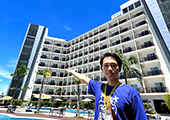 리얼 학교 방문기
 주말에 내가 쓸 비용은?
 최고가성비 이벤트 즐기기
 현지에서도 필자닷컴!
 현지에서 가능한









 필자 특급 혜택! 컨시어지 서비스







-
순위제목조회수
-
 MINUTE TO WIN IT
 46,822
 -
 Apple Eating Contest Game 34,297
 -
 SINGING BEE 23,776
 -
 DEAL OR NO DEAL23,401
 -
 rodeo masbatenio19,448
 -
 Luksong Lubid14,347
 -
 EGG AND SPOON RACE12,334
 -
 HULA HOOP12,214
 -
 BUNONG BRASO ( ARM WRESTLING)12,213
 -
 Tumbang Preso12,200


- 이름 : tutors
- 작성일 : 2013-03-04
- 조회수 : 4115
- 추천수 : 0
SUNGKA
Sungka is an important means for creating identity,
particularly for Philippine migrants. This can be seen in
sungka competitions, which are organized in the Philippines,
and in the representation of Philippine culture at cultural
festivals through Sungka demonstrations. The identity
forming function of the game is also a central theme in
Sungka and Smiling Irish Eyes, A Boy discovers what it
means to be Half-Irish and Half-Filipino by Natalie
Gonzales-Sullaway. The feminist poet and communication
scientist Alison M. De La Cruz wrote in 1999 a one-woman
performance called Sungka, which analyses the societal
and family-related expectations in regard to gender-
specific behavior and sexuality, race and ethnic affiliation,
by comparing it to a game of Sungka. De La Cruz also reflects
in her performance how she has come to terms with her
lesbian coming-out. Her poem That Age, which was part of
the performance, has become well-known in the America.


Moreover, sungka is still used by fortunetellers and prophets,
which are called on the Philippines bailan or maghuhula, for
divinatory purposes. Older people hope to find out with their help
whether the journey of a youth is favorable at a certain day,
and girls, whether they will marry one day, and, in case they will,
when this will be. The game is usually played outdoors because
there is a Filipino superstition about a house will burn down if it's
played indoors.

In past times sungka boards were also used for mathematical
calculations, which were researched by Indian
ethnomathematicians.
Although the sungka rules are not much different from
those of congkak, sungka is perceived as a genuinely Philippine
game by native players.
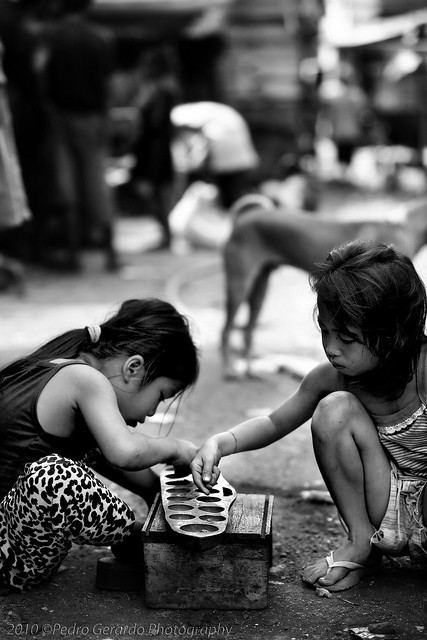
Rules
The oblong game board (sungka(h)an), which is usually carved in wood (e.g. mahagany), consists of two rows of seven small pits each. In addition, there are at either end a large store (bahay) for the captured stones. Each player owns the store to his right.
In each small pit are initially seven counters (sigay), usually cowrie shells.'
 |





- ·Dr.quack quack game (THE HUMAN
- ·SLIPPER GAME
- ·Bati-Cobra
- ·MONOPOLY GAME
- ·coconut shell race/sangkayaw
- ·Jack\'n\'Poy
- ·TEN-TWENTY
- ·tomato dance
- ·Serereng
- ·\"Araw - Lilim\" (Day and Nigh
- ·MAALIS-ALIS/ kaya, kulob (palm
- ·Bottle and Straw Game
- ·Habulan ng Baboy (chase and ca
- ·PING TAC TOE
- ·PITIK - BULAG









- ·Salapan Festival
- ·Empanada Festival (Batac City)
- ·PADUL-ONG FESTIVAL
- ·Kaumahan Festival in Barili
- ·KAGASANGAN FESTIVAL
- ·Lalin Festival in Asturias
- ·Tinabuay Festival
- ·Gayon Bicol Festival
- ·PINYASAN FESTIVAL in CAMARINES
- ·MAGAYON FESTIVAL
- ·BANAUAN FESTIVAL (BARANGAY.GUA
- ·The Tuna Festival in Gensan
- ·PINTOS FESTIVAL BOGO CITY, CEB
- ·Panaad sa Negros
- ·Pasalamat Festival






- ·CEBU WESTOWN LAGOON
- ·GREEN LAGOON, COMPOSTELA
- ·CALLAO CAVE
- ·MOUNT PINATUBO IN PHILIPPINES
- ·BATAN ISLAND in Batanes.
- ·CALAGUAS ISLAND, CAMARINES NOR
- ·AGHO ISLAND
- ·CARAMOAN ISLAND IN CAMARINES S
- ·SAMBAWAN ISLAND
- ·PLACES TO VISIT IN LANAO DEL N
- ·PLACES TO VISIT IN ZAMBOANGA C
- ·Places to visit in Rizal Provi
- ·HISTORIC TOWN OF VIGAN CITY, I
- ·CAMBUGAHAY FALLS, SIQUIJOR ISL
- ·TINUY-AN FALLS in BISLIG CITY,







-
서울센터 :서울 강남구 테헤란로27길 8, 10층 (역삼동, 엠타워)02-3482-0542
-
청주센터 :충청북도 청주시 흥덕구 서현동로 4, 3층(가경동)043-221-0543
-
부산센터 :부산광역시 부산진구 중앙대로 721-1, 5층(부전동)051-808-0515
-
창원센터 :경남 창원시 성산구 단정로 9, 12층 (상남동, 토토스빌딩)055-282-9345


-
사이트 접속자 통계
-
오늘389어제578
-
한달33,515누적12,529,168
-
일일최고94,672회원수20,299